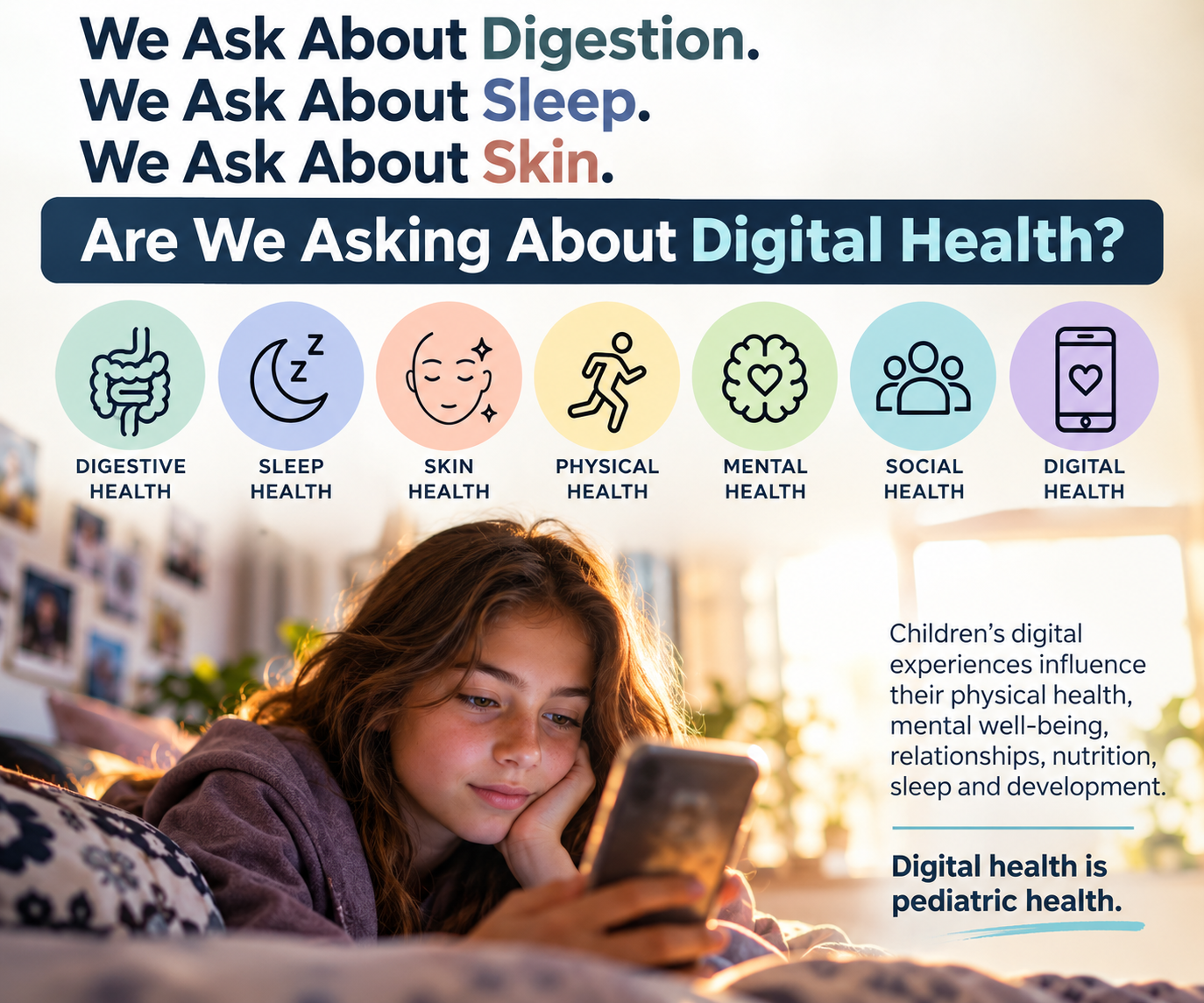
Beyond Screen Time: Why Digital Health Belongs in Every Pediatric Assessment
We routinely ask children about their digestion, sleep, skin, nutrition and physical activity. But are we asking enough about the environment where many of them spend a significant portion of their lives—the digital world?
As healthcare professionals, we are trained to look beyond the presenting complaint. A child with recurrent abdominal pain may need an assessment of nutrition, bowel habits, stress and family dynamics. A teenager with persistent acne may benefit from discussions about hormones, skin care, self-esteem and lifestyle. A young athlete experiencing fatigue requires us to consider sleep, recovery, nutritional adequacy and training demands.
Yet there is another dimension of children's health that deserves the same clinical attention: digital health.
Social media, gaming, messaging platforms, online communities, artificial intelligence and digital entertainment are woven into modern childhood. They influence how children communicate, learn, develop relationships, perceive their bodies and understand the world. For many young people, their digital environment is not separate from their everyday lives. It is an extension of their social, emotional and developmental experience.
If we are assessing the whole child, we cannot ignore the digital world in which that child lives.
Digital Health Is More Than Screen Time
Historically, conversations about children's technology use have focused primarily on the number of hours spent in front of a screen. While excessive or poorly timed screen use can interfere with sleep, movement and other important activities, duration alone tells us relatively little about a child's digital experience. Two adolescents might each spend three hours online, yet experience very different effects. One may be connecting with friends, learning a new skill, communicating with teammates or accessing a supportive community. Another may be repeatedly exposed to appearance-focused content, bullying, frightening messages, unrealistic fitness expectations or harmful health misinformation.
The number of hours may be identical. The clinical implications may be very different. Rather than asking only, "How much screen time do you have?" we should also be asking:
What are you doing online?
What kinds of content are you seeing?
How do you feel during and after using social media?
Do your online experiences affect your sleep, mood or confidence?
Is there anything happening online that makes you uncomfortable, worried or unsafe?
These questions can provide meaningful clinical information that a simple screen-time estimate cannot.
When Digital Experiences Present as Physical Symptoms
Children do not always recognize or communicate the relationship between their digital experiences and physical health. A 12-year-old with recurrent abdominal pain may be experiencing bullying through a school group chat. A 14-year-old presenting with fatigue and poor concentration may be staying awake late into the night responding to messages or worrying about social exclusion. A 16-year-old athlete with declining performance may be restricting carbohydrates after following fitness influencers promoting extreme dietary practices.
These examples remind us that a physical symptom may have a digital, psychological or social contributor. This does not mean we should assume that unexplained symptoms are caused by technology. Appropriate medical assessment remains essential. However, just as we investigate nutritional, hormonal, gastrointestinal and environmental contributors to health, we should consider whether a child's digital experiences are affecting their well-being.
Social Media, Body Image and Nutritional Health
One of the most clinically relevant areas of digital health is the relationship between social media, body image and eating behaviours. Children and adolescents are increasingly exposed to highly curated images, appearance-based comparisons, fitness challenges, supplement marketing and dietary advice delivered by individuals who may have little or no professional healthcare training.
Content promoting restrictive eating, extreme exercise, rapid body transformation or particular body types may be presented as healthy living. For adolescents navigating puberty, identity development and changing body composition, these messages can be particularly influential. In clinical practice, this raises important questions.
When a teenager suddenly eliminates entire food groups, where did that advice originate?
When a young athlete begins taking multiple supplements, who recommended them?
When an adolescent describes carbohydrates as unhealthy or expresses fear of gaining weight, what messages have shaped those beliefs?
For young athletes, these concerns are particularly relevant because restrictive eating and inadequate energy intake can contribute to impaired recovery, menstrual disturbances, bone-health concerns and Relative Energy Deficiency in Sport (RED-S).
Clinicians should feel comfortable exploring online nutrition influences without criticizing or embarrassing the young person. A simple question such as "Are there any athletes, influencers or online accounts whose nutrition advice you follow?" may open an important conversation. Our goal should be to help children develop critical thinking skills and a healthier relationship with food, exercise and their bodies—not simply tell them to stop using social media.
Digital Safety Is a Healthcare Issue
Cyberbullying, online harassment, impersonation, sextortion and AI-generated sexualized images are no longer concerns that can be addressed solely through schools or law enforcement. They can have serious implications for children's mental health, sense of safety, relationships and daily functioning.
Unless the clinician asks about online experiences, the underlying concern may remain undisclosed. Children may also hesitate to disclose digital harm because they fear being blamed, punished, having their devices confiscated or losing control over who learns about the situation.
This is why our response matters. We need to create opportunities for private, developmentally appropriate conversations and explain the limits of confidentiality before sensitive disclosures occur. When digital exploitation or harassment is identified, clinicians should assess immediate safety, psychological distress, coercion, threats and the potential need for additional protection or specialized support. The image may be fake. The harm is not.
The Digital Environment and the Developing Nervous System
Digital experiences can also influence sleep, emotional regulation, attention and stress. Late-night notifications, emotionally stimulating content, gaming, social comparison and the expectation of constant availability can interfere with healthy routines.
For some adolescents, the pressure to respond immediately to messages or remain connected to group conversations contributes to persistent worry and difficulty disengaging. For others, online activities offer relaxation, creativity, social connection and emotional support. The clinical task is not to label technology as universally harmful or beneficial. It is to understand how a particular child's digital habits and experiences interact with their nervous system, developmental stage, relationships and daily functioning.
When assessing sleep disturbances, anxiety, fatigue or concentration difficulties, digital routines should be considered alongside nutrition, medical conditions, psychological factors, school demands and family circumstances. Importantly, digital health interventions should be individualized. Removing access to an online community may be counterproductive for a young person whose most meaningful friendships or sources of support are found there.
Health Misinformation and the Rise of AI
Another emerging challenge is the growing influence of online health information. Children and teenagers increasingly encounter health advice through short videos, social media algorithms, wellness influencers and AI-powered chatbots. Some of this information is useful, accessible and empowering. Other content may be misleading, commercially motivated, inappropriate for children or presented without adequate consideration of safety.
An adolescent may receive advice about supplements, mental health, dieting, exercise, sexual health or self-diagnosis without understanding the limitations of the source. AI-generated responses can also sound authoritative while providing inaccurate or incomplete information. Rather than dismissing these sources, clinicians can use them as opportunities for education. We might ask:
"Where did you learn about this treatment?"
"What made that information seem trustworthy?"
"Would you feel comfortable showing me what you found so we can review it together?"
These conversations help develop digital health literacy while preserving the child's confidence and willingness to seek professional advice.
Making Digital Health Part of the Routine Pediatric History
Digital health assessment does not need to become a lengthy additional examination. A few thoughtful questions, adapted to the child's age and developmental stage, can be integrated into routine clinical care.
I suggest considering five areas:
1. Digital habits and routines: What platforms, games and online activities does the child use? How do these activities fit into sleep, school, physical activity and family routines?
2. Emotional experiences: How does the child feel after spending time online? Do particular accounts, interactions or experiences contribute to anxiety, sadness, comparison or distress?
3. Relationships and belonging: Does the child feel connected and supported online? Are they experiencing exclusion, bullying, pressure or harassment?
4. Health beliefs and behaviours: Is online content influencing the child's nutrition, body image, exercise, supplement use, mental-health beliefs or healthcare decisions?
5. Safety and support: Does the child know what to do if something online makes them uncomfortable or unsafe? Is there a trusted adult they can approach?
For adolescents, some of these questions should be asked privately, with a clear explanation of confidentiality and its limits. For younger children, discussions with caregivers about content, supervision, online interactions and family digital routines may be more appropriate. As with any clinical history, the objective is not to interrogate or judge. It is to understand.
Moving Beyond the Screen-Time Lecture
There is a risk that digital health discussions become another opportunity to tell parents what they are doing wrong or to lecture teenagers about their phones. That approach is unlikely to build trust. Most families are already navigating a rapidly changing digital environment with limited guidance and competing demands.
Many parents are trying to balance safety, independence, social connection, education and practical realities. And many adolescents genuinely benefit from aspects of their online lives. Our role as clinicians is to help families identify what is supportive, what may be harmful and what changes could improve health.
That may involve adjusting bedtime routines, reducing exposure to distressing content, supporting healthier online communities, strengthening digital literacy, addressing cyberbullying or referring for mental-health support. The right intervention depends on the child.
Digital Health Is Pediatric Health
We would not consider a pediatric assessment complete if we consistently ignored nutrition, sleep, development or the child's social environment. Digital experiences deserve similar consideration. They can influence physical symptoms, emotional well-being, self-esteem, relationships, health behaviours and the way children understand their own bodies.
Digital health should not be treated as a separate specialty concern that is only explored when a child presents with obvious technology-related difficulties. It belongs within comprehensive, developmentally appropriate pediatric healthcare.
As healthcare professionals, we need to remain curious about the environments shaping children's health—even when those environments are changing faster than our traditional clinical frameworks. The next time a child presents with abdominal pain, fatigue, insomnia, anxiety or unexplained changes in behaviour, remember to ask about more than their physical world.
Ask about their digital world, too.
Because for today's children, digital health is not separate from health. It is part of it.
Dr. Gayle Maguire, ND
Children’s Natural Health | Healthcare Education, Ethics & Advocacy
This article is intended for professional education and does not replace individualized clinical assessment, safeguarding obligations or applicable professional standards.